Introduction: Search Is Changing for Michigan Businesses
For years, Michigan businesses have focused on one main digital marketing goal: showing up on Google.
That usually meant trying to rank for searches like:
- “best marketing agency in Michigan”
- “Detroit roofing company”
- “Ann Arbor web design”
- “local SEO services near me”
- “SEO and GEO best practices in Michigan”
Traditional SEO still matters. Businesses still need optimized websites, helpful content, strong local signals, and technically sound pages. However, search is no longer only about ranking in a list of blue links.
Today, people are discovering businesses through:
- Google Search
- Google Maps
- AI Overviews
- Bing generative search
- ChatGPT-style answers
- Voice search
- Featured snippets
- Review-based recommendations
- Local “near me” searches
This is where GEO, or Generative Engine Optimization, becomes important.
GEO is the process of creating and optimizing content so AI-powered search tools can understand, summarize, and recommend it. Instead of only asking, “How can my business rank higher on Google?” companies also need to ask, “How can my business become a trusted source in AI-generated search results?”
For Michigan businesses, this shift creates a major opportunity. Many local companies are still only focused on basic SEO. Businesses that begin using GEO strategies now can build stronger visibility, trust, and authority before competitors catch up.
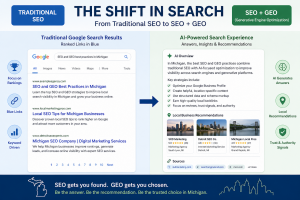
What Is GEO?
GEO stands for Generative Engine Optimization.
It focuses on optimizing content for AI-powered search experiences that generate answers instead of only listing websites.
Traditional SEO asks:
- Can Google crawl this page?
- Is the keyword included?
- Does the page match search intent?
- Are there backlinks?
- Is the page technically healthy?
GEO asks those questions too, but it adds a few more:
- Is the content clear enough for AI to summarize?
- Does the page answer questions directly?
- Does the author or business show real expertise?
- Are claims supported with trustworthy sources?
- Are entities, locations, services, and topics easy to identify?
- Is the content structured in a way that AI systems can extract?
Google explains that AI Overviews are designed to give users a quick understanding of complex topics and provide links for deeper exploration. Bing has also described generative search as an experience where AI reviews sources, generates a response, and includes links so users can validate or explore further.
That means businesses should think beyond keyword rankings.
The new goal is to become:
- Easy to find
- Easy to understand
- Easy to trust
- Easy to cite
- Easy to recommend
For Michigan businesses, GEO is especially useful because local search often depends on trust, location, reputation, and clear service information.
SEO vs. GEO: What’s the Difference?
SEO and GEO are closely related, but they are not exactly the same.
Think of SEO as the foundation. GEO is the next layer.
Traditional SEO focuses on visibility in search results
SEO helps your website appear in organic results, map results, featured snippets, and other search placements. It includes:
- Keyword research
- On-page optimization
- Title tags and meta descriptions
- Internal linking
- Backlinks
- Technical SEO
- Local SEO
- Content quality
- Page speed
- Mobile usability
GEO focuses on visibility in generated answers
GEO helps your brand become part of AI-generated search experiences. It includes:
- Clear definitions
- Concise answers
- Strong headings
- FAQ sections
- Entity optimization
- Author expertise
- Credible citations
- Structured data
- Original examples
- Locally relevant context
Simple comparison
| Area | SEO | GEO |
|---|---|---|
| Main goal | Rank in search results | Be referenced in AI-generated answers |
| Format | Webpage listings | Summaries, answers, citations |
| Focus | Keywords and rankings | Entities, trust, clarity, authority |
| Content style | Helpful pages | Helpful, structured, easy-to-summarize pages |
| Local impact | Google Maps and organic results | AI recommendations and local answer summaries |
The best strategy is not SEO or GEO.
It is SEO and GEO together.
That is why a page about SEO and GEO best practices in Michigan should be supported by deeper articles like this one. Your main page can act as the pillar, while supporting content explains each related topic in more detail.
Why GEO Matters for Michigan Businesses
Michigan has a wide range of businesses, industries, and local markets. A company in Detroit may have a different search strategy than a company in Grand Rapids, Ann Arbor, Lansing, Traverse City, or South Lyon.
Some businesses depend on local foot traffic. Others serve clients across the entire state. Some target homeowners, while others target manufacturers, healthcare providers, schools, law firms, or professional service companies.
Because of this, Michigan businesses need search strategies that are both local and flexible.
A Michigan business may want to appear for searches like:
- “best accountant in South Lyon”
- “commercial cleaning company Detroit”
- “Grand Rapids family photographer”
- “Michigan manufacturing marketing agency”
- “Ann Arbor med spa SEO”
- “local SEO for Michigan small businesses”
- “how to optimize for AI search in Michigan”
As search becomes more conversational, people are asking longer and more specific questions. Instead of typing only a short keyword, users may ask:
- “How can a Michigan contractor show up in Google Maps?”
- “What are the best SEO strategies for small businesses in Michigan?”
- “How can a local company appear in AI search results?”
- “What is the difference between SEO and GEO?”
- “How can a business build trust online in a local market?”
These searches require clear, helpful answers.
Businesses that create content around these types of questions have a better chance of being discovered by both traditional search engines and AI-powered search tools.
The Core Principles of GEO
A strong GEO strategy is built on five core principles:
- Clarity
- Authority
- Structure
- Local relevance
- Trust
Each of these principles helps search engines and AI-powered tools understand the value of a business’s content.
1. Clarity: Make Content Easy to Understand
Clarity is one of the most important parts of GEO.
Content should be easy for both people and search systems to understand. That does not mean the content should be overly simple. It means the message should be direct, organized, and specific.
A vague sentence like this is not very useful:
“We help companies improve digital visibility with advanced solutions.”
A clearer version would be:
“We help Michigan businesses improve visibility in Google Search, Google Maps, and AI-powered search results through local SEO, content strategy, and GEO-focused optimization.”
The second version explains:
- Who the service is for
- Where the business operates
- What platforms matter
- What services are involved
- What outcome the customer can expect
That kind of clarity helps readers understand the value faster. It also helps search systems identify what the content is about.
Ways to Make Content Clearer
Businesses can improve clarity by using:
- Short paragraphs
- Specific headings
- Bulleted lists
- Tables
- Definitions
- Examples
- FAQ sections
- Step-by-step explanations
- Internal links to related topics
Clear content is not just easier to read. It is also easier to summarize, quote, and recommend.
2. Authority: Show Real Knowledge and Expertise
GEO is not only about answering questions. It is about answering them in a way that shows real knowledge.
Authority comes from depth, consistency, and usefulness.
A business can build authority by publishing content that fully explains its services, industry, process, and customer challenges.
Authority Signals May Include:
- Detailed service pages
- Educational blog posts
- Case studies
- Testimonials
- Reviews
- Author or team bios
- Local examples
- Original insights
- Consistent publishing
- Clear explanations of complex topics
For example, a marketing agency that wants to show expertise in SEO and GEO should not only have one page about SEO. It should build a larger content ecosystem around related topics.
That might include articles about:
- Local SEO
- Google Business Profile optimization
- Generative Engine Optimization
- Content clusters
- Technical SEO
- Michigan search behavior
- Website authority
- AI search visibility
The more complete and useful the content is, the easier it becomes for readers and search engines to view the business as a knowledgeable source.
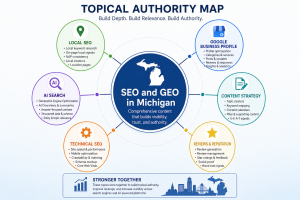
3. Structure: Organize Content for Readers and Search Engines
Strong structure makes content easier to read, scan, and understand.
This matters for users, but it also matters for search engines and AI-powered systems.
A well-structured article allows readers to quickly find the information they need. It also helps search systems identify key sections, questions, and answers.
Strong Content Structure Includes:
- One clear H1 title
- Organized H2 and H3 headings
- Short paragraphs
- Bulleted lists
- Numbered steps
- Comparison tables
- FAQ sections
- Descriptive image alt text
- Internal links
- Clear conclusions
Headings should be specific. Instead of using a vague heading like “More Information,” use a heading that explains the actual topic.
Weak Heading Examples:
- More About SEO
- Local Stuff
- Other Tips
- Final Thoughts
Strong Heading Examples:
- What Is the Difference Between SEO and GEO?
- How Michigan Businesses Can Improve Local SEO
- Why Google Business Profile Matters for GEO
- How to Build Trust in AI Search Results
Specific headings help readers understand what each section covers before they even read the full paragraph.
4. Local Relevance: Make Location Part of the Strategy
For Michigan businesses, local relevance is a major part of both SEO and GEO.
Local relevance means the content is not generic. It clearly connects the business, service, and audience to a specific place.
Simply adding the word “Michigan” to a title is not enough. The content should include meaningful local context.
Michigan-Specific Signals Can Include:
- City names
- Service areas
- Local industries
- Local customer examples
- Regional search behavior
- Chambers of commerce
- Local publications
- Community partnerships
- Michigan-specific challenges
For example, a generic sentence might say:
“Local businesses need SEO to rank better.”
A stronger, more localized version would say:
“A service business in Metro Detroit may need location pages for Detroit, Livonia, Royal Oak, Novi, and South Lyon, while a statewide company may need content that targets Michigan industries such as manufacturing, healthcare, education, and professional services.”
The second version is stronger because it gives real local context.
Examples of Local Content Angles
A Michigan business could create content around topics like:
- Seasonal customer behavior in Michigan
- Service needs during Michigan winters
- Industry trends in Metro Detroit
- Small business marketing in Grand Rapids
- Local search behavior in Ann Arbor
- Statewide service pages for Michigan clients
The more relevant the content is to the local audience, the more useful it becomes.
5. Trust: Make Content Worth Recommending
Trust is one of the most important parts of GEO.
AI-powered search tools are designed to provide helpful and reliable answers. If a business wants to be included in those answers, its website needs to look trustworthy.
Trust cannot be built with keywords alone. It comes from the overall quality and credibility of a website.
Trust Signals Include:
- Accurate business information
- Clear contact details
- Complete service descriptions
- Customer reviews
- Testimonials
- Case studies
- Secure website experience
- Updated content
- Helpful links
- Clear authorship
- Professional branding
- Consistent business name, address, and phone number
For local businesses, trust also includes reputation.
A business with strong reviews, clear service information, and a helpful website is more likely to earn confidence from both customers and search engines.
How AI Search Changes Content Strategy
AI search is changing the way businesses should think about content.
In the past, many businesses created one page for one keyword. For example, a company might create a page targeting “SEO company Michigan” and focus mainly on repeating that phrase in strategic places.
That approach is no longer enough.
Search engines and AI tools are getting better at understanding topics, questions, and relationships between ideas.
This means businesses should focus less on one exact keyword and more on answering a full set of related questions.
Instead of Writing Only for Keywords, Write for Questions
A page about GEO should answer questions like:
- What is GEO?
- How is GEO different from SEO?
- Why does GEO matter?
- How does AI search work?
- How can a local business improve AI search visibility?
- What role does local SEO play?
- What type of content works best for GEO?
- How does structured data help?
- What mistakes should businesses avoid?
This makes the content more complete and more useful.
Use the Answer-First Method
The answer-first method is a simple GEO writing technique.
It means answering the main question directly before adding details.
For example:
Question: What is GEO?
Answer-first response:
GEO, or Generative Engine Optimization, is the process of optimizing website content so AI-powered search tools can understand, summarize, and recommend it in generated answers.
After that direct answer, the content can explain examples, benefits, and strategy.
This format works well because it gives readers immediate value. It also makes the information easier for search systems to interpret.
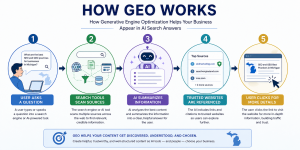
Practical GEO Checklist for Michigan Businesses
Businesses can use the following checklist to evaluate whether their content is ready for SEO and GEO.
Content Clarity Checklist
A strong page should include:
- A clear title
- A direct answer to the main topic
- Short introduction
- Descriptive headings
- Bulleted lists
- Examples
- FAQ section
- Internal links
- Updated information
Authority Checklist
A trustworthy website should show:
- Who created or reviewed the content
- Why the business understands the topic
- Real service experience
- Local market knowledge
- Case studies or examples
- Supporting sources when needed
- Consistent content around related topics
Local Relevance Checklist
Michigan-focused content should include:
- Michigan references
- Specific cities or regions
- Local industries
- Local customer challenges
- Statewide or regional examples
- Community or business context
Technical Checklist
A strong website should have:
- Fast loading pages
- Mobile-friendly design
- Crawlable content
- Clean URLs
- Optimized images
- Secure HTTPS
- Internal links
- Structured data where appropriate
- No major indexing problems
Trust Checklist
A business website should include:
- Complete contact information
- Google Business Profile
- Reviews
- Testimonials
- Service pages
- About page
- Author or team information
- Privacy policy
- Consistent name, address, and phone number
These elements help create a stronger foundation for both search engines and potential customers.
The Role of Google Business Profile in GEO
Google Business Profile is usually discussed as a local SEO tool, but it also supports GEO.
A complete Google Business Profile helps search engines understand important business details, including:
- Business name
- Category
- Services
- Location
- Hours
- Website
- Reviews
- Photos
- Service areas
For local businesses, this information matters because customers often search for services nearby.
Important Google Business Profile Elements
A strong Google Business Profile should include:
- Accurate business name
- Correct primary category
- Relevant secondary categories
- Complete service list
- Business description
- Photos
- Hours
- Service areas
- Website link
- Appointment or contact link
- Regular updates
- Review responses
Why Reviews Matter
Reviews help build trust with potential customers. They also give search engines more context about a business.
A strong review strategy includes:
- Asking satisfied customers for honest reviews
- Responding to positive reviews
- Responding professionally to negative reviews
- Keeping responses specific and helpful
- Avoiding fake or incentivized reviews
- Building reviews consistently over time
A short review response like “Thanks!” is better than no response, but a more detailed response can provide stronger context.
For example:
“Thank you for choosing us for your local SEO strategy. We’re glad we could help your Michigan business improve its Google Business Profile and website visibility.”
This response is professional, helpful, and naturally reinforces the services provided.
Structured Data and GEO
Structured data is code that helps search engines better understand a webpage.
It does not guarantee rankings or AI visibility, but it can help organize information in a way that search systems can read more easily.
For businesses focused on SEO and GEO, structured data can support content clarity.
Useful Schema Types for Local Businesses
Depending on the page, businesses may use:
- LocalBusiness schema
- Organization schema
- Article schema
- FAQPage schema
- Service schema
- Review schema
- BreadcrumbList schema
- WebPage schema
Examples of Structured Data Use
A blog article can use Article schema.
A service page can use Service schema.
A local business website can use LocalBusiness schema.
An FAQ section can use FAQPage schema when the questions and answers are visible on the page.
Structured data should match the visible content. Businesses should not use schema to claim information that does not appear on the page.
Internal Linking and GEO
Internal linking helps connect related pages on a website.
It also helps readers find more useful information. For search engines, internal links help show how different pages relate to each other.
A strong internal linking strategy can support topical authority.
Why Internal Links Matter
Internal links help:
- Guide readers to related content
- Show which pages are most important
- Connect related topics
- Improve crawlability
- Support keyword relevance
- Keep users on the website longer
Natural Internal Link Examples
A business writing about GEO may link to related topics using phrases like:
- SEO and GEO best practices in Michigan
- Michigan SEO strategy
- local search visibility
- AI search optimization
- Google Business Profile optimization
- content strategy for local businesses
The goal is to make links useful and natural. Internal links should help readers continue learning, not feel forced or repetitive.
Content Formats That Work Well for GEO
GEO-friendly content should be easy to read and easy to scan.
Different content formats can make an article more engaging and more useful.
1. Comparison Tables
Comparison tables help readers understand differences quickly.
Example:
| Strategy | Best For | Why It Matters |
|---|---|---|
| SEO | Google rankings | Helps users find a website |
| Local SEO | Map visibility | Helps nearby customers discover a business |
| GEO | AI-generated answers | Helps AI tools understand and recommend content |
| Content Clusters | Authority building | Shows depth around a topic |
2. Checklists
Checklists are useful because they give readers something practical to follow.
Example:
- Is the page clear?
- Does it answer the main question?
- Does it include local context?
- Does it include examples?
- Does it link to related content?
- Is it updated and accurate?
3. FAQ Sections
FAQ sections work well because many searches are question-based.
Example:
What is GEO in digital marketing?
GEO stands for Generative Engine Optimization. It is the process of optimizing content so AI-powered search tools can understand, summarize, and recommend it.
4. Step-by-Step Guides
Step-by-step content is helpful because it gives readers a clear process.
Example:
- Audit current search visibility
- Identify important keywords and questions
- Improve service pages
- Add GEO-friendly blog content
- Strengthen internal links
- Optimize Google Business Profile
- Add structured data
- Track performance
5. Real Examples
Examples make content feel more useful and less generic.
Instead of saying:
“Create local content.”
A stronger example would be:
“A Michigan landscaping company could publish seasonal guides like ‘When to Start Spring Lawn Care in Southeast Michigan’ or ‘Best Landscaping Plants for Michigan Winters.’”
Specific examples show real understanding of the audience.
Common GEO Mistakes to Avoid
As GEO becomes more popular, many businesses will try to optimize for AI search. However, not every strategy will be effective.
Here are common mistakes to avoid.
Mistake #1: Writing Only for AI
GEO should still be people-first.
Content should be helpful, natural, and readable. If an article sounds robotic or overloaded with keywords, it may not build trust with readers.
Mistake #2: Repeating the Same Keyword Too Much
Keyword stuffing does not create authority.
Instead of repeating the same phrase over and over, use natural related terms, such as:
- AI search optimization
- local SEO
- Michigan digital marketing
- search visibility
- generative search
- content strategy
- topical authority
Mistake #3: Publishing Thin Content
Short, shallow content usually does not show much expertise.
For complex topics like SEO and GEO, businesses should create detailed resources that answer multiple related questions.
Mistake #4: Ignoring Local Context
A page that targets Michigan should actually be relevant to Michigan.
That means including local examples, cities, industries, customer needs, and regional search behavior.
Mistake #5: Forgetting Internal Links
A strong article should connect to other helpful pages.
Without internal links, content can feel isolated. Internal linking helps build a larger content ecosystem.
Mistake #6: Not Updating Content
SEO and AI search change quickly.
Content should be reviewed regularly to make sure it is accurate, current, and useful.
Example GEO Content Plan for a Michigan Business
A strong GEO strategy takes time. It is not built from one blog post.
Businesses can create a simple 90-day plan to begin improving search visibility.
Month 1: Build the Foundation
Focus on:
- Core service pages
- Google Business Profile
- About page
- Contact page
- Main educational blog content
- Local landing pages if appropriate
- Website speed and mobile usability
Month 2: Publish Authority Content
Create articles around topics such as:
- What is GEO?
- SEO vs. GEO
- Local SEO in Michigan
- How to rank in Google Maps
- Google Business Profile optimization
- AI search optimization
- Content strategy for local businesses
Month 3: Strengthen Trust and Relevance
Add or improve:
- Case studies
- Testimonials
- FAQ sections
- Industry-specific guides
- City-specific content
- Internal links
- Structured data
- Updated older pages
This approach helps create a stronger, more complete website over time.
How to Measure GEO Success
GEO measurement is still developing, but businesses can track several important signals.
Traditional SEO Metrics
Businesses can monitor:
- Organic impressions
- Organic clicks
- Average search position
- Click-through rate
- Indexed pages
- Keyword queries
- Traffic to blog posts and service pages
Local SEO Metrics
For local search, businesses can track:
- Google Business Profile views
- Calls
- Website clicks
- Direction requests
- Reviews
- Map rankings
- Local keyword rankings
GEO Visibility Signals
Businesses can also manually test whether their brand or content appears in AI-powered answers.
Example searches or prompts include:
- “What are SEO and GEO best practices in Michigan?”
- “How can a Michigan small business optimize for AI search?”
- “What is the difference between SEO and GEO?”
- “How should a local company build online authority?”
- “What are the best local SEO strategies for Michigan businesses?”
Over time, businesses can track whether their content is being discovered, summarized, or referenced in AI-powered search experiences.
FAQ: GEO for Michigan Businesses
What is GEO?
GEO stands for Generative Engine Optimization. It is the process of optimizing website content so AI-powered search tools can understand, summarize, and recommend it in generated answers.
Is GEO replacing SEO?
No. GEO does not replace SEO. It builds on SEO. Businesses still need strong technical SEO, helpful content, local optimization, and authority signals.
Why does GEO matter for Michigan businesses?
GEO matters because customers are using search in new ways. They may discover businesses through Google, Google Maps, AI Overviews, Bing generative search, voice search, and chatbot-style answers.
How can a business optimize for GEO?
A business can optimize for GEO by creating clear, helpful, well-structured content. Strong headings, direct answers, local examples, FAQ sections, internal links, reviews, and structured data can all help.
Does Google Business Profile help with GEO?
Yes, Google Business Profile can support GEO indirectly by making business information clearer and more trustworthy. It helps search systems understand location, services, reviews, and local relevance.
Should small businesses care about GEO?
Yes. Any business that depends on online visibility should pay attention to GEO. This includes contractors, agencies, healthcare providers, law firms, restaurants, real estate professionals, retailers, and B2B companies.
Conclusion: GEO Is the Next Layer of Local Search
Search is becoming more conversational, more AI-driven, and more focused on trusted answers.
For Michigan businesses, this creates a new opportunity.
Traditional SEO is still important, but it is no longer the full picture. Businesses also need content that is clear, structured, locally relevant, and trustworthy enough to be understood by AI-powered search tools.
A strong GEO strategy helps businesses improve visibility across:
- Google Search
- Google Maps
- AI Overviews
- Bing generative search
- Local search results
- Long-tail conversational queries
- Future AI-powered discovery tools
The businesses that adapt early will have an advantage.
By combining SEO and GEO, Michigan companies can create stronger content, build more trust, and make it easier for both customers and search engines to find them.
Need Help With SEO and GEO in Michigan?
Understanding GEO is only the first step. The next step is building a content and search strategy that helps your business appear where customers are already looking.
Learn more about SEO and GEO best practices in Michigan and how local businesses can improve visibility in both traditional and AI-powered search results.
Leave a Reply